Tuesday, 18 February 2014

Post 142 Visit to Kokufu

I went to Tokyo a couple of weeks ago to go to Kokufu-ten, the 88th in the series. Over about 8 days that I was there I also visited Omiya, Tokoname and Kyoto.

The bonsai competition was held in the Tokyo Metropolitan Museum of Art. For the first time this year there were two phases for the show with 170 trees shown over 4 days, followed by a changeover day and then another 170 trees.
There was a wide range of species shown; lots of pine and juniper but just as many deciduous species and even some bouganvillia. The trees are mostly big with just a few smaller than 600mm, apart from a small shohin display. They were of course all absolutely stunning. It was great to be able to get close and look within the tree and go beyond the usual two dimensional observations we make from pictures.
It’s winter in Japan so of course the deciduous trees were bare showing amazing branch structure.

 Image
 The organisers eventually publish a hard cover folio of pictures of the trees and so photography in the show was not allowed, so no pictures I’m afraid; apart from this overview taken by a privileged visitor.
But they do run a sales area and the same rule did not apply there. Most of the trees offered for sale were also of a very high standard and I have a few pictures to show you.


This and the next one are general views in the inside area


 The junipers were in great condition and must have been in a warm environment for the winter. Any juniper that had been grown outside was by this time quite a russety brown in colour.


 There were a few pots for sale and if you look closely you'll see the prices on these ones. The top blue one was going for Yen 300,000. In the show there were a lot of old pots with no concern given to the odd chip or blemish. The generally showed plenty of patina.


 I was quite surprised at the prices of the trees. I had expected that they may have been asking quite a bit more. This juniper was tagged at Yen 200,000. That's got to be a bargain. For $500 to $600 you could buy any  number of really high quality, old, well developed trident shohins for example. If only importation was a reasonable option.
 
 This is the area outside, just more of the same. This was taken at the end of the first 4 days show. On the next day a winter storm swept through for the changeover day (that must have been fun) and this area would have been covered in a 200mm of snow.

Monday, 3 February 2014

Post 141 Another firing - more pots and tanuki

Just opened the kiln after another interesting firing; 4 commission pots, one for me and two new tanuki.

The first one is a tallish blue oval with a lower beading. Final size at 256mm x 200mm x 74mm. This one is glazed in a light blue that I've not used for a while. The goal for both the ovals was to get a reasonable level of glaze differentation / mottling.


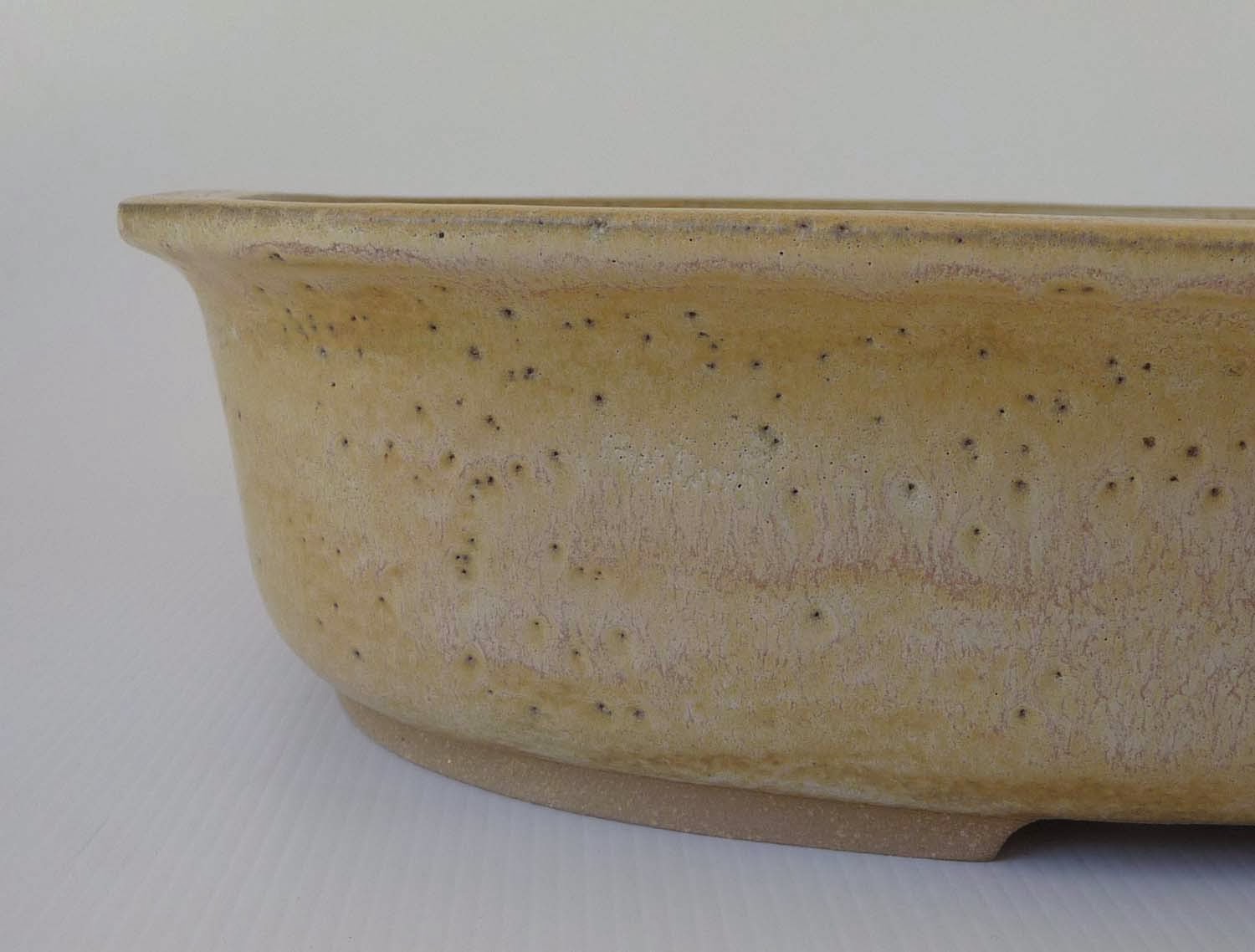
 The next one is also an oval with straight sides and no wall decoration. Final dimensions are 259mm x 198mm x 62mm. It's glazed in my very repeatable and predictable breaking beige glaze.


The next one is a low round pot 285mm diameted and 50mm high. It has a convex wall and lower beading - much like the profile on some of my Wasen pots.  Here are a couple of those from November 2012. 


The glaze was formulated to be a little more yellow mustard in colour but none the less has come out a very practical beige mustard. I don't get a lot of calling for round pots but this profile and wall height makes an attractive and useful pot.
After I made this pot I've actually made a couple of smaller diameter versions for myself, that are still drying, to house my first ceramic tanukis. The 'footprint' for these would make an oval pot too long so a round pot is the logical option. Since planting them in October 2012 they have progressed nicely and I'll be putting them into the new pots next spring.
 
The next one is a shohin pot.


 It's a bowed wall rectangular pot, 167mm x 120mm x 49mm, with simple lines and minimalist glaze application.


The last one is a bowed wall rectangular pot, 390mm x 285mm x 79mm, glazed lightly with a brown toned 'antique' finished glaze.

In December last year I made two more ceramic tanuki and posted a picture of one of them as work in progress. They've now gone right through the firing pipeline and are ready to use. The first one is T5, at 290mm high:


This detail shot shows the grain simulation carving. I put a lot more detail into these two than previous models. You can see here the track to house the tree.

 The next one takes the complexity up another notch. It finished off at 325 high. It was quite a challenge to make in the first place let alone make sure it wasn't damaged in moving it into and out of the kiln and setting it up for firing. I fired both in the horizontal position to overcome slumping at maturity and had to use lots of firing props to keep them in shape during vitrification. The little curvy extension on top of the second one was most at risk; incredibly fragile just as dried clay and very deformable under maturity firing conditions.


In this one I did much more 'leather hard' carving to hollow out the stump and make some elongated fissures in the trunk.
 

I have a couple of sergent juniper whips ready to put in place on these and want to get them in place to lock in some growth while there is still some growing time this season.

Friday, 17 January 2014

Post 140 Three new pots

My latest firing has been a very interesting one, with a couple of new experiments.

The first one was with Pot No 102. This is quite a large pot coming in at 452 x 352 x 82.


The glaze is a layering of two different glazes, which can produce some unexpected results. The base glaze is a favourite of mine that I have used often. It is the cream beige that breaks brown/red where thin, as on Pot 87. Over that glaze I've applied one of a differrent composition which has an antique, thoroughly offwhite colour that is a bit hard to describe., last used on Pot 91. Both of these were in a firing that featured on Post 124.

The base glaze is a Custer Potash glaze and the upper one is made on Nephylene Syenite. In the melting process the lower glaze generates gases which bubble when they get trapped by the over glaze, until they break out leaving an indentation. The glaze is fairly immobile so this causes some interesting surface movement without flowing.
 
Here is a detail shot which shows some the the results of that interaction between the glazes, leaving a very interesting colouring and surface. This one is a keeper.


I've talked about the different shapes of pots before. It is hard to tell what they are with the low angle side shot. Pot 102 is one of my compound ovals.  In Post 123 I showed a picture of a few bisque pots, some compounds and a couple of ovals.


Here is a three quarters view which best shows off the pot.  The reason I mention shape is because today's last pot is of a slightly different shape; but we'll come to that.


 The next pot, Pot No 103 finished at 433 x 344 x 92 is another compound oval. This is one of my unglazed simulator glazes which I've used a bit recently, last time on Pot 98 posted in December.    It can produce a variety of colours depending on how thick and uniformly the glaze is applied.

 So that brings us to the last one for this firing, Pot No 104 at 389 x 280 x 76, just a little smaller than the other two.


First off let's have a top down look to show the difference in shape from Pot 102. Might just be just me but there is a difference, less bowing in the front and back walls and tighter radius corners, to make it a bowed wall rectangular pot.


The full frontal view shows another 'first use on a pot' glaze which I will add to my unglazed simulators; hence the application on the feet as well. It is a dark brown, just as expected with a nice little differentiation through the application.

 And the end view.


And a three quarters view again to emphasize the different shape; makes an attractive pot.


And finally a detail shot of the glaze.